Last night there was a storm so we drove our rental car to the end of the driveway in the evening, to avoid the precarious drive down the hillside when the road was muddy. The next morning we had a wonderful breakfast, said our goodbyes, and headed down to the car. Unfortunately, when we got there we discovered the car had been burglarized.
While they broke the driver’s side (right) window, they didn’t use the trunk pull to open the trunk. Rather, they took a metal fence post and pried open the trunk. So frustrating. Fortunately, we hadn’t left anything in the car of significance in the vehicle (well, actually, I left my jacket but they didn’t steal that).
In the end, it was just a huge inconvenience. First, we had to drive to the police station and file a report. This involved filling out forms in triplicate. Except, the policeman fills in the form but in first person – under the assumption that the vast majority of people needing a report can’t write. Also, there are a few peculiarities. Consider, for example, the highlights below:
“Nobody had permission to break into my car.”
Next we headed back to the rental company to sort out things with them and fill in the necessary paperwork. Unfortunately, no one was there – even though they hours posted on the door indicated they should be open for several more hours. We waited two hours and they eventually showed. I was pleasantly surprised how much empathy they had regarding the burglary. In the end, I filled out another incident report and they assigned me a new car. We will get the bill in the email. And, hopefully, our credit card insurance, where we filled another report, will cover the expense.
Love like there is no tomorrow, fight poverty and injustice, and seize today’s adventures
Last year I was driving along and listening to the (country) song, “Live Like You Were Dying” by Tim McGraw and singing it with all my heart. I felt like those words are a core part of my motto, “Be all that you can be.” The lyrics for the chorus are:
I went sky divin’ I went Rocky Mountain climbin’ I went 2.7 seconds on a bull named Fu Manchu And I loved deeper And I spoke sweeter And I gave forgiveness I’ve been denying And he said someday I hope you get the chance To live like you were dyin’
I confess my first association with “Live Like You Were Dying” was with activities like “sky diving, rocky mountain climbing,” traveling, etc. However, when I’m on my deathbed, assuming I even get the chance to ponder my life, I’m not sure I will be grateful for all the adventure-type activities, and I doubt I will be regretful of any such activities missed. However, the answer isn’t as simple as that. Perhaps there are three perspectives on a life that “Lived Like You Were Dying”
When I can no longer go sky diving, will I regret not going; will I regret not visiting every country in the world, or visiting the Palawan Island when those activities are no longer possible? While I may still have many years of life left, at some point there will be things that I wanted to do but I can no longer do. Will I be disappointed that I didn’t do some of those things?
My heart breaks at the extreme poverty and injustice at the margins of society where hope is lost. Also, those of us in the Western world are incredibly blessed and we can do something about that suffering. I’m confident that the more I do to improve people’s lives, (especially if I get to know those people) the more fulfillment I would have. I don’t expect I will regret not seeing Antarctica if it is because I was consumed with alleviating poverty or injustice (at a minimum Elisabeth and my approach accomplishes this using the profits from IntelliTect).
When I’m on my deathbed perhaps my reflections will be solely focused on time not spent with those I love or not having those that loved me and will miss me at my bedside?
In summary, I suspect that when I can’t be adventurous anymore, I will regret not having been more adventurous. Similarly, when I’m not as capable of helping those experiencing extreme injustice, I will wonder if I should have done more. But, when I’m on my deathbed, time with loved family and friends will be my focus, satisfaction with helping others will be cathartic, and adventure will be irrelevant.
Surprisingly, however, I find that this last sentence does not suffice for the guiding insight. Why should sentiment on your deathbed be the primary consideration for how you live most of your life? Instead, I choose to:
Love like there is no tomorrow, fight poverty and injustice, and seize today’s adventures
(I’m eager to improve this last sentence and request suggestions… but for now I’m choosing published over perfection.)
I have been working on our vehicle, the Codiwompler, with significant help from others (especially Albert Merkel) since December. However, this last weekend was a scramble to get all the last-minute adjustments made to our rig and I’m very grateful for all the help: Mark & Marianne, Josh & Meshach, my neighbor Mark, Benjamin, and Elisabeth.
It was a scramble, but by 9 PM, I was ready to drive off for the port of Vancouver, BC, where I was shipping the vehicle from.
There are a only a couple remaining items left when the car arrives in South Africa. Firstly, the turbo is leaking. Secondly, I want to add some mosquito netting to cover the gaps in the canopy walls so that we can cook under the canopy and not get carried away by the mosquitos once we travel further north.
In June 2022, when our overlanding Africa in 2023 idea first emerged, I started perusing the Internet for a vehicle. I considered all types: Land Rovers, Jeeps, Unimogs, Mercedes trucks, Sprinter vans, etc.
In the end, my uncle Rob, who is a Land Rover expert and an experienced African overlander as well, recommended we take a Land Cruiser. What? Why would a Land Rover expert recommend a Land Cruiser? Simple, they are less finicky and you can get parts anywhere in Africa. And so, I narrowed my search to a Land Cruiser with the following features:
Double cab
Diesel
Left-Hand Drive (for right-hand driving like in the USA)
Manual Transmission
No new-fangled electronics that I couldn’t repair while off-road
Unfortunately, this still left me with countless possibilities. The first Land Cruiser was made in 1951 and there have been numerous models since and innumerable options and variations on each model. Also, I came to find out that there were no diesel Land Cruisers in the United States. No such car was ever manufactured here. I continued to scour the Internet. I contacted a seller in the Phillippines and looked at shipping from there. I connected with an Overlander in the UK and even met up with him in Scottland (when my family happened to be there) to take his Land Cruiser for a test drive.
During our trip through the UK, I connected with a seller in Sandpoint, ID who happened to have a vehicle that met all the above criteria (well, except the double cab). I informed him I was interested but that I couldn’t see the vehicle until I returned in a couple of weeks. He told me to check in with him when I returned.
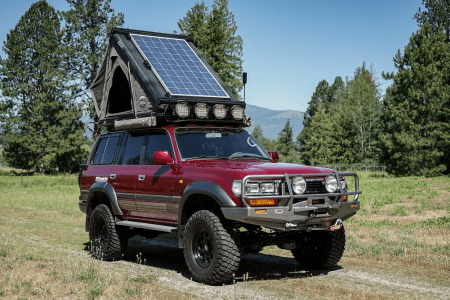
Lo and behold, it was still there when I got home and I went up to check it out over the weekend. Eric Edmonds accompanied me as my advisor. (Elisabeth pre-approved any decision I might make – making her obviously exceptional.) The fact that I found a unicorn, a 1996 manual, diesel 80-series Land Cruiser, so close to home, was remarkable. Furthermore, it had been outfitted for Overlanding, with a rooftop tent (RTT), lifted suspension, flood lights, and numerous other enhancements. The car had been imported from Honduras. In addition, it had recently returned from traversing the TransAmerica Trail (TAT). (“… a 4,253-mile (6,845 km) transcontinental vehicular route, intended as a recreational pathway across the United States using a minimum of paved roads, traveled by dual-sport motorcycles, off-road vehicles, or touring bicycle.”)
All this to say, I’m now the owner of a diesel 1996 Toyota Land Cruiser HDJ80L which I have named the Codiwompler. Codiwompler a derivative of coddiwomple, “to travel in a purposeful manner towards a vague destination” – a very apt description of my traveling style.
This is the vehicle we have chosen as our trusty steed as Benjamin and I traverse cities, towns, villages, deserts, forests, mountains, storms, mud, rivers, more mud, and so much more in our Overlanding adventure across Africa.
Last week, I purchased flights from my home in Spokane, WA to Cape Town, South Africa, and then returning from Brussels, Belgium back to Spokane – 5 months later. To get from Cape Town (the Southernmost point in Africa) to Brussels, Benjamin and I plan to drive along the West Coast of Africa to Tunis, Tunisia (the Northernmost point in Africa), through 20-28 countries, across two deserts and numerous areas of unrest/conflict along with many other challenges.
Route sketch from Cape Town to Tunis along with various detours
Lest you think the route is more defined than it is. My initial route was a printed-out map of Africa that I drew a line on along the coast. For the updated version above, I asked Google to map a route from Cape Town to Tunis and then dragged the route around to avoid areas where I know there is conflict, the route is impassable, or based on my intuition of what I thought might be “interesting.”
Why you might ask? Well, my son (Benjamin) just graduated from college, and before he does something responsible (like get a job) or irresponsible (I’ll let you come up with your own examples), he suggested we go on an adventure. Driving across Africa seems like a good example of such an adventure, so that is what we are planning.
Benjamin and Mark completed work on the Land Cruiser
Hanna and I flew to the Southern Tip of Baja California Sur, Mexico this week to continue learning to kiteboard. Last year, at the same time, we went to Punta Chame, Panama for the same. We arrived Sunday evening with the plan to start sailing Monday but there was no wind. We settled instead for a beautiful sunrise and a slack line. The latter seemed like a good practice for balancing on a kiteboard.
Hanna (of course), made it across. I was less astute at the task. Regardless, given no wind, we decided to go exploring West, on the Pacific coast side of the peninsula.
We parked just above Playa Bonita, near the construction of a new resort (The Palm) and I was surprised at how deserted the beach was. It stretched for miles but there were only a few cars and accompanying visitors. From there we hiked North along the coast for less than 2 miles, up and over the rocks looking down on Playa Las Tinajas. Remarkably, there was no one there. Literally, in the entire time we hiked, we only saw one family at the start and then no one. (It’s not like we were on the Eastern Coast of Madagascar or something.)
There were pelicans and seals a little way out from the beach – having a good little laugh at the joy of beach life I expect.
When we returned back to the car we drove to Playa Los Cerritos and stayed a little way out of the new construction area at Cerritos Beach Inn. We chose this location to be the night we splurged for accommodations with an ocean view room. (In hindsight, there wasn’t much point because we loved sitting downstairs overlooking the beach so basically only used the room for sleeping. We appreciated it nonetheless.)
In the morning, a father and son walked along the beach for 40 minutes to the hotel to have breakfast. Upon calling the rest of the family to drive over and join them, the dad realized he had the keys. Whoops! I offered to drive him back, picking up gasoline on my return to the hotel.
We left the hotel around 11:30 heading to Pozas Budistas (translated Buddhist Pools). This was casually recommended by the Kartchner’s – who neglected to mention details like, it’s a 4-wheel drive road, be sure you have a full tank of gas, don’t forget to take lots of water as you are going to be in the high desert for several hours, and oh… by the way, when you get there you won’t find any signs. (Admittedly, they told us to count the 11 water crossings but we missed this detail.) All this to say, the drive was wonderful, but not exactly a paved road.
Not only was the drive an adventure, but the pools themselves were (mostly) great as well. We hike in at one of the upper pools (rather than from the bottom), and so the first pool was a slide. Awesome! That is except for the fact that I took the first slide and when I emerged I was freckled with baby leeches. Yes, really!! What? Who recommends this to their friends I wonder? (The rattlesnake wasn’t a big deal because although we wore sandals on our hike, we didn’t see the rattler until we were back in the car.)
Regardless, not to be deterred, we hiked down the creek jumping along the giant boulders until we reached the main pool. And, since it was hot, Hanna volunteered that I test this pool for leeches as well. It was clean, refreshing, and cool. We swam. We were in a high desert and swimming. It was wonderful.
Awesome rock slide… if it wasn’t for the leeches at the bottom.
We hiked back to the car and continued our journey through the desert to Cañón de la Zorra and Zorro Falls (this was when we saw the rattlesnake).
Zorro Falls…. wait what? A waterfall and freshwater swimming hole in the middle of the desert? Really? Yes, really! It was stupendous.
Should I be suspicious if the cabin has candles and a candle holder?
In the evening (Wednesday night) we stayed in the ecolodge, Rancho Ecologico Sol De Mayo, just above the falls. Internet was only available at the entrance, not at our cabins, and there was no cell service. They do have a restaurant, but it was closed while we were there. If you visit, bring your own food though, as they have a great cooking setup with a grill (they provide the charcoal) and a kitchen with dishes. Rather than staying in the cabin, in fact, you can camp. In addition, they have a host of animals from peacocks to pigeons, and rabbits to horses (no relation to dinner). I loved the atmosphere of the ecolodge and, best of all, it allowed you to access the waterfalls after hours. When we went down in the evening, and had it entirely to ourselves. In the morning, I visited as well and took a glorious swim while the sun came up and shone into the pools. It was stupendous.
The wind was forecast back at La Ventana by 11 AM Thursday morning, so we headed out, a 1.5-hour drive. Unfortunately, wind is not as reliable as that and, while Hanna got out, I didn’t. Furthermore, Hanna spent the morning in the water as there wasn’t quite enough wind and she wasn’t able to actually get up on the board – though it was exhausting nonetheless. In the afternoon we headed back to the hotel for a nap and to catch up on work.
Astoundingly… Friday it was too windy. Wow… this sport is picky about the conditions – at least for beginners like us. Not to be bored, however, we took the opportunity to drive to Playa Balandra – which was beautiful. Unless you hike in, it is only open for entry at 8 AM and 1 PM and we timed it just right to make the 1 PM entry. (We were towards the back of the queue but we still made it into the park.) There is an overlook from which you can see both the inlet and the beach of this epic location. Down in the water, you can walk the entire area with the water below your waist. (I expect the sunrise is spectacular and I’d like to hike in early one morning if I’m ever back in the area.)
Playa El TecolotePlaya El Tecolote
Back in La Ventana, we stopped by the natural hot springs at El Sargento. The timing was great because the tide was still coming in so we made a pool in the hot springs (which were too hot to start), and then waited for the tide to come in to cool it down.
Afterward, we headed to dinner. The restaurant was empty and the owner informed us that the menu didn’t correspond with the food available. We told him that suited us, and we welcomed him to make us something great – just not anything Hanna is allergic to. We both enjoyed our dishes and then switched so we could sample each other’s. Unfortunately, after switching, Hanna’s dish now had some unknown substance that triggered a significant allergic reaction. She took the necessary immunotherapy but it’s especially disconcerting when you are so far from significant medical facilities. Furthermore, while the medicine is life-saving, the after-effects are an unpleasant experience, to say the least.
On Saturday, we finally had wind, not too much and not too little. It’s about time! We watched the usual sunrise from our bedroom window – yes, it was like that every morning we stayed in La Ventana. And, around 10 AM, we watched as the wind blew in from the North. You could see it in the water. And, by 10:30 AM, it was time to sail.
We sailed from the Elevation Kiteboarding School and took the jet ski option – which meant they took us upwind via jet ski and then instructed us as we sailed (or struggled to sail) around the bay.
After the morning session Hanna was exhausted while I decided I deserved another afternoon of the sun in my eyes, water up my nostrils, and saltwater “hydration.” And, since we couldn’t catch an early flight out in the morning on Sunday, we may as well try again in the morning before rushing out for the 2-hour drive back to the airport.
Needless to say, we are close, but at the end of a second week (18 hours in total for me and 12.5 hours for Hanna) we still aren’t quite independent kiteboarders yet. I expect next time, but that’s what I thought last year so….
This weekend some friends and I took an off-road trip on the Washington Back Country Discovery Route (WABDR). We debated all winter on where to go and what route to take but, with all the recent snow, and some logistics around a couple of participants wanting to leave a day early, we settled on starting in Ellensburg and heading South and then North.
There were seven of us in all:
Eric Edmonds and Josh Dahlstrom driving a 2020 Tundra
Albert Merkel with his daughter driving Mitsubishi Montero
Michael Stokesbary driving a Jeep Wrangler, and
Benjamin and I taking up the rear in a diesel 1996 Toyota Land Cruiser (HDJ80L)
The main purpose of the trip was to test-drive the Land Cruiser which, thanks to Albert’s help, has undergone some major improvements including regearing the differential, upgrading to bead-locked wheels, rebuilding the brake system, installing rear differential lockers, re-doing the auxiliary power, replacing the auxiliary fuel tank with a 42-gallon tank, and installing new storage draws in the rear.
Vantage Bridge over Wanapum Lake
Our drive to Ellensburg was flawless and we filled up the auxiliary fuel tank with 18 gallons of diesel there. We then took the circuitous route (I think we turned around four times), before arriving at the start of the rugged version of the WABDR. We initially started on the route via Umptanum dirt Rd. within a few meters, Albert decided to take the more “rugged” route so we turned around one more time and began our adventure. The road wound around and down into the valley at Durr Road Campsite but this was not for us. We started up the other side which was quickly covered in snow. We all down-shifted to 4×4 low and headed up with Albert in the lead and Stokesbary taking up the rear.
Unfortunately, after about 15 miles, Eric radios us that the Tundra is stuck. Hmmm… We wait at the top as attempts are made to continue. Eventually, Mike makes his way around Josh and joins us at the summit and the Land Cruiser (which needs a name – suggestions welcome) heads down to try to help. After a couple of attempts, however, and the interruption of another car (not in our party) descending, Josh and Eric give up and start heading back to Ellensburg to purchase some chains.
On the way back, however, they radio us and suggest we camp at the Durr Road Campsite. This works for the rest of us and we head back down to the campsite for the night.
We set up camp and Benjamin, with Josh’s guidance, cooked a stew for dinner in the Afghan pot. Excellent!!
We awoke with a beautiful sunrise and Benjamin’s, again with Josh’s guidance, cooked an egg souffle – albeit this time in the dutch oven. Mmmm!
Rather than head back South, we decide to drive through Ellensburg, pick up chains for the Tundra, and then drive over to Cashmere – to try our luck traveling North on the WABDR. Alas, it was closed for exclusive snowmobiler access, so Albert lead us to a different trail. We started out on dirt with a caution sign – what we assumed was just a suggestion – and then progressed to mud.
At this point, we all aired down. (I took the Land Cruiser down to 9.5 PSI thanks to the fancy new bead-locked wheels that Albert installed.) However, the mud didn’t last for long as we were shortly driving on three to four feet of hardened snow. I was impressed with the lack of concern, but everyone seemed undeterred, so we continued up the mountain. In spite of the newly acquired chains, the Tundra got stuck, but Josh successfully was able to get it moving again on his own.
It was this next stretch, however, where the adventure really started – and we stopped. Albert was in the lead, Stokes and Josh next, while Benjamin and I took up the rear. Josh gets stuck. Yay! It’s about 3:30 PM. Time to pull out the winch, shovels, and recovery boards.
Overhead on the radio, “I think we have reached the end”, says Albert. “Yup, we are a little stuck.” Mike and I are going to go radio silent for a while as we figure this out.
We pull out the winch and start helping Josh. No, go! We tried angling (pun intended) off a tree but the Tundra would not budge. Recovery boards… nope. Shovels are out and we start digging. The Land Cruiser, while not stuck, didn’t have sufficient traction to pull Josh out. Thanks to suggestions, we anchor it to a tree. More pushing, shoving, digging, etc. Still no luck. It is starting to get dark. Benjamin volunteers to cook dinner.
There were a few less-than-ideal details:
Josh doesn’t have the correct fitting to undo his spare tire.
The Land Cruiser was missing the handle for the bottle jack (details).
The connection on the winch controller was failing and the winch was failing to activate.
It was getting really icy as the evening went on.
The Tundra was so close to the cliff side that you couldn’t enter/exit from the passenger side as the door couldn’t open.
The Montero blew a fuse so Albert had to jerry rig it directly to the battery (fuses just require replacing anyway).
In an attempt to descend, the Jeep skids perpendicular to the trail.
The Montero is high-centered and there are no nearby trees to anchor to.
Focusing on the Tundra, and in desperation we allow the winch to pull the Tundra to the side with a little extra vigor and the beading gives out and its tire goes flat. Stink! This truck is completely high-centered to the point that even taking out his spare tire from under the vehicle is challenging. (Benjamin continues cooking dinner with Eric’s accompanying conversation.)
After some hemming and hawing, Josh decides to attempt to reseat the wheel with gasoline and a lighter. Yes… this is the time for Macgyver-type measures. And, what do you know, it works the first time. Wow!!
Yeah… it’s been 4.5 hours and we finally have the first car unstuck.
Josh and I reverse down to a “passing” spot, Josh stays on the trail and the Land Cruiser passes by off-trail. No getting stuck. we head up to the next rig. Here we find Mike’s Jeep rotated 90 degrees on the road. And after pulling his rig out (another few hours), we again switch spots and the Land Cruiser heads to the top to find Albert’s Montero. We tried with the winches (the Montero also had a winch), and some raw pulling. Regardless, the Montero didn’t budge. To reduce the likelihood of the Land Cruiser getting stuck, we drop the air pressure down to 4.5 PSI. And, while it came close, it was always able to self-rescue. Yes!!!
Eventually, we take to digging, rotating, and digging some more, slowly pulling the vehicle around.
At 3:30 AM, 12 hours later, all cars are unstuck and we head down to Josh and Mike’s car to camp for the night.
In the morning we wake up fresh and ready for a new day. It doesn’t take long, though, before we all decide to head home. We’ve had all the practice we need for this trip, all concentrated into a single 12-hour block. Although the Tundra got stuck one more time, we all knew the digging drill and were able to rescue it without much ado.
Once off the trail, we head to Cashmere Riverside Park for a picnic. Josh whips up dessert in the dutch oven (yes, really… it was wonderful). A great finish to an adventurous trip!!
I have really enjoyed them not only because the writing is good, but also because there are a remarkable number of thoughtful lines that emerge from the books. Backman does an amazing job at observing life and pointing out what is obvious once you are told, but invisible before that.
Examples from his latest novel, Winning:
The most unbearable thing about death is that the world just goes on.
She never let him be less than what he was capable of.
We fool ourselves that we can protect the people we love, because if we accepted the truth we’d never let them out of our sight.
Our children never warn us that they’re thinking of growing up, one day they’re just too big to want to hold our hand, it’s just as well we never know when the last time is going to be or we’d never let go.
Being married is easy, she usually thinks. You just pick an argument you’re really good at, then repeat it at least once a week for all eternity.
…
(The author is Swedish and these were translated into English, which immediately gives it a little credence for me.)
Note: I rarely read fiction so anything on the topic should be considered with a grain of salt as I am not an expert and don’t really know what I’m talking about. All I’m saying is that I appreciated these books. I’ve also read several other books by Fredrick Backman that were also good. I’m mentioning these because they were my favorite.
Benjamin and I arrived at San Salvador, El Salvador at 6 AM, giving us plenty of time for a full day upon arrival. I decided to take an Uber to our accommodations (31 USD) and then make plans from there. (While I found the accommodations on AirBnb, I decided against making the reservation there and instead just showed up since the AirBnb host name was Hostal Punta El Zonte – Dorm Room and a search resulted in the location on Google Maps.) The hostel was a surfing hostel located right on the beach. The waves came all the way up to the deck when the tide was up. You could also sit and watch the surfers right from the hostel and listen to the waves all night. Cool!!
While T-Mobile is great in that it connects in almost any country at no extra cost. It limits connectivity to 2G, which is relatively painful when you are trying to research travel. Fortunately, our Uber driver was willing to pull over at a local stand and help me get connected with Tig0 at a cost of 5 USD. What I especially appreciated was his willingness to enter his El Salvador Identity card when signing up my account. (He did ask me to destroy the card when I left, but it was entirely an act of trust – which I much appreciated.) Feel free to reach out to our driver, Melvin Mena on WhatsApp at +503-7130-5297, if you are ever in the area and need a driver:
We relaxed for a few hours and caught up on emails and work before heading out for a hike in the afternoon. We started out walking up the creek right from hostel beach. It was very muddy to start but nothing to worry about as it was a short while before we were wading in the creek itself. We walk to the main road and then continued North along the road. Along the way we saw women washing clothes in the stream along with children bathing. On the road there were stalls selling fruits, especially near the bus stop. It was hot after only a mile or so, we navigated back toward the beach at the next village. Unfortunately, we couldn’t traverse all the way back to our hostel because the tide was in and we couldn’t navigate around the rocks without getting soaked (admittedly I got soaked by a surprise wave, but even so, we scrambled up the rocks to a private house, got scolded for being on private property, and then allowed to exit via the gate rather than going back the way we came. 😊
Back at the hostel, the owner suggested we rent scooters and go exploring. They were 25 USD each and we headed out to see Lake Ilopango, navigating through San Salvador. Unfortunately, San Salvador is 2,000 ft. above sea level, and by the time we reached there, a storm was brewing and it was considerably colder. Scratch that, it started to pour. We took refuge under a bridge for an hour before venturing out again only to encounter even heavier rain within 15 minutes. Bummer! We scrapped plans for the lake and looked for food and shelter. We selected a local pizza joint and headed there until the rain mostly subsided. Upon finishing our afternoon pizza snack, we decided to head back to the beach as fast as we could in the hopes of minimizing the time in the rain. We still got wet, but it warmed up as we approached the coast and wasn’t that bad. Of course, riding a scooter in the rain is a little precarious so we were relieved when we arrived without incident. We had dinner at the hostel before heading to bed. Admittedly, while we didn’t reach our destination, we enjoyed the journey and overall had an enjoyable day.
In the morning, I took a beautiful walk along the beach at sunrise and then spent the morning working on the deck. Once Benjamin was awake, we breakfasted, and decided to head out to El Tunco where we could upgrade from scooters to 250cc motorbikes. We waited on the main road for what seemed a ridiculous 45min. for the local bus to take us <10 km South (not sure why but the first bus didn’t stop at our stand). The bikes were significantly more powerful and hopefully safer if it rained. We headed East to Tamanique Falls. Upon reaching the town we asked a local mom for a guide. She made some calls and looked around but eventually her 11-year-old son, Horacio, came strolling down the road from school and she called him to take us. He didn’t seem particularly taken with the idea and took his time to get changed out of his school uniform. Upon realizing that he was going to ride on the back of the motorbike with me, however, I think he warmed to the idea considerably. He told me this was his fist time – not just on the motorcycle, but also in being a guide. I was excited to give him a chance.
The beginning of the trail was rock paved and relatively easy, but in short order it turned to dirt. And, unfortunately, when we started to go downhill in the mud the bike slipped out from under us and dropped, shattering the mirror. Ughh!!! Only minor scrapes and bruises for both Horacio and me. (I confess we were cautioned when renting not to take it on the trail but the 11-year-old kid encouraged us saying it was easy and way faster. Yeah, I know. I’m not interested in your opinion on the topic. 😊) We parked the bikes on the side of the trail and continued the rest of the way on foot. The turnoff could easily have been missed so I was grateful for our guide. The park was 1 USD per person (guide was free) despite the sign stating entry was 2.50 USD. The first view of the water was a jumping spot. Horacio encouraged me to go for it, but I asked him to demonstrate first. Rather than just jumping from the top, he cautiously climbed town to a lower point and then jumped. Encouraged, I went for it from the top. It wasn’t particularly high, and it was wonderful to hit the water and cool off. I jumped a couple more times. There was a second pool to jump into that was considerably higher, but the climb out was precarious (with a 100ft drop onto rocks) and Horacio wasn’t willing to demonstrate because of fear he confessed. I decided not to risk it as I really didn’t know the route back out. (I had a slight regret for not having an older guide to demonstrate the bigger jump, but I overcame my self-disappointment when I saw the next part of the falls.)
We hiked down to two additional falls and pools – which were progressively spectacular. I’m so glad we came. I (of course) took another swim in the pool of the tallest falls. Spectacular!
Back in the town of Tamanique, we met up with Horacio’s mother, father, and brother and took the former for a quick ride on the motorbike. I loved the family and would have invited myself to dinner if we didn’t have to get the bikes back. Instead, we borrowed a basin and washed off my bike to remove any evidence of falling in the mud. While I couldn’t fix the mirror, the rest of bike looked unharmed. We rode home, refilled the gas, and took a couple beach stops before returning the bikes.
At El Tunco beach we spent the late afternoon watching the World Junior Surfing Championship. These kids were awesome. Next we stopped in a local outdoor eatery for pupusas (a first for us) and then on the way back to the main road accepted an invitation to church. Hearing such gusto in the songs was wonderful.
Knowing the buses stopped running at 7 PM, however, we excused ourselves at 6:25 PM and headed to the main road. After waiting 30 minutes a bus came, dropped off a couple passengers, but then took off again before we boarded. Hmm… what’s the deal. By now it was dark. Fortunately, a small pickup truck stopped upon seeing my tentative thumb, and we hitched a ride back to El Zonte and our hostel for one more night. Having eaten already, we crashed early with alarms set for 3:15 AM to catch a shuttle and then a boat to Nicaragua.
Our shuttle picked us up at 3:30 AM, yes, 3:30 AM and drove us directly to the coastal town of La Union, El Salvador. We arrived around 7 AM, and waited about 1.5 hours in which time we also went through immigration (to exit El Salvador).
At about 8:30 or so we walked out onto the pier and boarded a boat to cross the Gulf of Fonseca from El Salvador to Nicaragua. The boat ride was about 3 hours, with beautiful weather and some great views. Upon crossing the border into Nicaragua, which was in the middle of the gulf, we had to put on life jackets. (I guess the risk of capsizing in Nicaragua than El Salvador. Or perhaps swimming becomes more difficult on the Nicaragua side of the gulf. 😊)
We beached at the village of Potosi, Nicaragua. It was fun to enter the country by walking up the beach from the boat. On shore they made a thorough manual search of our luggage before allowing us to walk up to the immigration office. It took perhaps an hour for the Nicaragua immigration process, but it didn’t matter since our shuttle hadn’t arrived by the time we finished. The shuttle drove us to León where we rented a car. (The alternative was a 110 USD private car to Rivas, so I considered the cheaper two-day car rental a steal in comparison.) Of course, by the time we were driving away with the car we didn’t have sufficient time to catch the ferry we were hoping anyway, so we adjusted plans and headed for Granada, Nicaragua instead.
Puerto de GranadaIn Front of Malecon De GranadaThe shore of Lake Nicaragua… Awful!Iglesia San FranciscoIglesia XaltevaIglesia La Merced (Granada)Bell Tower of Iglesia La Merced (Granada)Iglesia GuadalupeCathedral of GranadaCalle La LibertadCalle La Libertad
In the morning, we woke up an went for a walk around town. It had a stereo typical Central American feel with some beautiful parks and splendid cathedrals. It was great to walk around except for the staggeringly littered Lake Nicaragua shoreline. Really? The cause is obvious as we repeatedly saw Nicaraguans just throw trash to the ground, but why they weren’t bothered by it was baffling.
Following our walk I worked for a few hours before we packed up an headed to the ferry to travel to the world’s biggest fresh water island, Ometepe. Unfortunately, we missed the first boat trying to figure out our plans so we didn’t actually catch the ferry (leaving out car parked at the dock) till 2:30 PM – at a total cost of approximately 10 USD for both of us. The boat, however, took a full hour to go the 6-9 miles. At this point we adjusted our plans to catch the 4 PM return ferry leaving only half an hour on Ometepe. Obviously, while not enough to do anything significant but we quickly walked up to the Iglesia Católica Santa Ana, and then, in my wisdom, I casually directed us to purchase some ice cream. My thinking was the surely the boat had arrived late and couldn’t possibly unload and reload in 30 minutes. It turns out, I was wrong. By the time we were back at the dock the boat ramp had lifted off of the ramp. Not deterred, I ran and jumped all the while yelling at Benjamin to do the same. He stopped making the gap longer. I called again for him to jump and he came to his senses and jumped. For some reason, the boat attendants were less than impressed but hey, we made it so.
Heading to Ometepe IslandIglesia Católica Santa AnaHeading back form Ometepe Island
Upon reaching shore again we quickly went to the car and started the 2.5-hour drive to Masaya Volcano. We arrived after dark and within 45 minutes of closing. Again, I had stopped for food – Nicaraguan Franga – on the drive. Benjamin decided to be principled and stay away from street food which meant I had to eat his portions. Sheesh! Now I must also fear his potential Ï-told-you-so tomorrow if the food plays shenanigans with my stomach.
We were able to look down into the caldera and see the magma bubbling below. This was my first time seeing molten rock (either magma or lava) and it was very cool. I was pretty excited that we had made it.
From the volcano we decided to make the drive all the way back to León at night. This was considerably faster than the journey since there was far less traffic and there are no police at night (and very few during the day as well). We arrived at our hotel by 10:15 and headed for bed. Another great day with a little adventure and some cool sights to boot.
The next morning, we drove to see the Santa Ana volcano. Benjamin took some drone shots before we heading back to León. Next up was haircuts and then a walking tour of León. In addition to seeing a few sites, our tour guide shared about revolutionary history of Nicaragua along with the 21st century circumstances under Daniel Noriega’s dictatorship and repression. I appreciated his teaching on the failed 2018 student uprising. It was especially interesting to contrast it with our host, who had a belief that not all societies are cut out for democracy until they reach a certain level of education and sophistication. A level that she didn’t believe Nicaragua had reached yet. (See Nas Daily’s, Why Democracy Isn’t Working video for additional thoughts on the topic.)
On the roof of Cathedral-Basilica of the Assumption of the Blessed Virgin MaryOn the roof of Cathedral-Basilica of the Assumption of the Blessed Virgin MaryOn the roof of Cathedral-Basilica of the Assumption of the Blessed Virgin MaryColegio La AsunciónStreets of LeónCathedral-Basilica of the AssumptionPatio del Principe Catedral LeónMercado CentralSt. Francis of Assisi ChurchSt. Francis of Assisi ChurchHotel El Convento
By this time we had heard though tour 3:30 AM shuttle back to El Salvador through Honduras was delayed until morning, giving us another night in León and potentially some time in the morning as well. When we finally did leave, it was 11 AM.
My initial attraction to GiveDirectly, and why IntelliTect decided to support them last year, was the studies they did at the onset to show the positive impact of the cash transfers and verification that, in fact, recipients overwhelmingly made positive choices in what to do with the money. Rather than drinking, drugs, or gambling, the recipients chose to purchase a cow, roof, health insurance, a child’s education, home improvements, or something equally worthwhile. Overwhelmingly, the recipients net worth and quality of life improved significantly. During my visit this tip, it was a blessing to be able to see their gratitude, excitement, and accept their thank-yous. While I only visited four or five households this week, I came away with a strong confirmation that these recipients were exceedingly grateful for the cash transfers and that they were not making unhealthy choices about how to spend the funds. In fact, in the Miller, their choice was especially strategic (at least in terms of income generation).
The GiveDirectly team I met with is relatively young and eager about the mission of GD. Everyone had a college/university degree (the academic discipline of the degree didn’t really matter to GD which makes sense to me). Furthermore, based on the team I interacted with, they were all good hires – meaning the GD employees were hard working, believed in the mission, were thoughtful, and eager to improve. In Rwanda, like Uganda, having a degree doesn’t guarantee you a good job, so GD gets to choose the best applicants. (That said, Rwandan unemployment figures are extremely low – less than 2% – which seems very suspicious.)
Two question areas remain, however, and I’m grateful for the ongoing discussion with GiveDirectly as they help me to resolve them:
Is income improved over time and by how much? GD’s goal is that people would escape extreme poverty. However, remarkably, they don’t have any data/studies to show this is, in fact, achieved. I’m very surprised by this given my initial evaluation of them at the onset of IntelliTect’s donations was that they were data and research driven. As a result, the following questions arise:
After five years (for example) have recipient households escaped out of extreme poverty? GiveDirectly doesn’t have any data to say that they do.
What is the percentage of increased income? One study in Uganda, which GD provided for me, shows that over twelve years income goes up a total of 17% (I assume this is after inflation as inflation alone in that time period would be more than 25%). A recipient who started at 1 USD/day would, therefore, be earning less than 1.20/day after 12 years. Another study in Kenya concluded that, “At four years, the families that received GiveDirectly’s cash were not meaningfully better off than control families.”
What is a family’s income to start? (Seemingly, GD was not gathering this information in their census – at least for the one I participated in?)
What is a family’s income after five years (and more)?
Why had GD not been measuring income improvement both before and at a significant amount of time after, in fact why wasn’t it one of their main measures? One obvious reason for not measuring a long time afterwards would be cost, but surely this is the very purpose of the donations and, therefore, you should verify it is working in the long term – even given the expense. At a minimum, use Rwandan government provided data and verify it with sampling.
The other organizations I met with during my East Africa visit learned that training in personal financial, gender sensitization, marital conflict (especially when money become available), and income generation were critical to escaping poverty. What was GD doing such that this training wasn’t needed and how did they verify it?
I have no doubt that net worth and quality of life improved with cash transfers (even perhaps after five years though I haven’t looked for the research to support this). How do you measure effectiveness of poverty alleviation when considering increased income versus net worth & quality of life improvements?
Why is GiveDirectly’s detection of household conflict 10% of the Rwandan wide figures of domestic GBV in the last 12 months?
Why was GD’s detection on conflict across their clients (~2%) so vastly different from UN Women’s (at the time of this writing, 20% experiencing GBV over the 12 months)?
How much was the emphasis to not have conflict presented during the community meeting skewing their ability to detect the conflict?
Surely GBV was included in what GD considered conflict or, was it not a significant factor in determining who should receive cash transfers? If not, why not?
If GBV was not conflict enough to disqualify a household from receiving a cash transfer, what conflicts were significant to disqualify them (however rarely)?
Why does GiveDirectly’s overhead reporting differ from GiveWell’s evaluation on them?
GiveDirectly’s response to my email on this topic stated (and is consistent with their website):
The discrepancy boils down to a difference in calculation. We calculate efficiency as Cash transfers ÷ [Cash transfers + cost of delivery] which historically comes to ~90%. GiveWell calculates it as “Cash grants make up 83.0% of GiveDirectly’s all-time incurred expenses.” The difference is that we break out our measures into two distinct business systems, (1) cash transfers and (2) fundraising to deliver as cash, with a core performance metric for each; whereas GiveWell groups them all together.
I’m concerned about this for multiple reasons.
The most significant is that they receive money that is restricted to a specific expense category (namely fundraising) rather than the generally preferably unrestricted donation. And, as such, they credit the donations from you or me as going directly to the recipient (well, except for transferring the money). In other words, while generally restricted funds are less preferable, because GiveDirectly has restricted funds for fundraising and they are crediting themselves as having a lower overhead for your or my donations than everyone else even though, in fact, their fundraising is nothing special, it is just that the unrestricted funds that you or I are donating, are not going towards fundraising (or perhaps even overhead).
GiveDirectly’s fundraising may not be particularly good but they are playing by different rules so, on their website, they look better than other organizations website shows the fundraising as a normal cost. This seems suspiciously disingenuous – and hard to decipher – and outside the spirit of truth in reporting. Help me understand?
Questions:
When, on their website, GiveDirectly doesn’t include their fundraising costs in the measure of giving efficiency and yet compares themselves to other organizations, are they subtracting the fundraising costs from other organizations metrics?
Where does overhead, such as the cost of management cost or accounting, fit in their spending report?
What makes GiveDirectly special such that they believe that not reporting the cost of fundraising the same as everyone else is acceptable? Is it simply that they have a donation restricted to fundraising? What if everyone did the same, would we end up with more truth or less?
Tonight we fly home, Kigali->Entebbe->Amsterdam->Seattle->Spokane. A total of around 30 hours. Before that, however, we get to go meet with some of the specific households that IntelliTect supported with their donations to GiveDirectly(GD) in 2021. It’s about a 4-hour drive to the village of Gitwa, and we will only be able to stay about an hour before heading back, but none the less, it provides an opportunity to hear first hand about the impact.
Upon arriving in Gitwa, we first went to the government village officers where we met with the section head. He had one of his staff present the impact on the community, using PowerPoint and a projector, comparing before and afterwards.
The impact included:
100 percent of the households had purchased government health insurance (no doubt a government encouraged purchase)
100 percent of the households had electricity – supporting a minimum power equivalent to three lightbulbs
The vast majority owned a cow (another strongly government encouraged purchase)
<more data to come>
After the presentation we got to wonder around the community and I was asked to select any household I would like to visit. Note, as your read these description, they are each anecdotes. They can’t be used to measure overall success of the GD program. None the less, I was encouraged, blessed even, by the interactions.
The Miller – Mugabe Moise
The first building we came to was a flour mill and the owner, Mugabe Moise, was outside. Prior to GD he was renting flour mill equipment and leveraging some training he had attended. Using the cash transfer, he purchase the flour mill equipment, and a second one, outright. He was paying ~5 USD/day for the electricity to run the mill and about 15 USD/month for maintenance. In addition, he seemingly employed one person to run the mills. As a result, he calculated his net profit at the equivalent of 5 USD/day, significantly higher than the 1.90 USD/day ppp value set as the extreme poverty delineator. (Although, I confess I didn’t find how many, if any others, in his household he was supporting.) This was clearly a success story. I suspect he was very likely already above or trending above the poverty line even before the GD money, but regardless, it was a huge success and I’m excited about what the future holds for this gentleman.
The Excited Widow – Musabyimana
This woman, Musabyimana, was so excited she invited us into her home. In the corner was a small wooden bench standing on it side. She explained that before receiving the money, that was the only furniture she had. Now, she had this wonderful set, and the bicycle. She also had a cow and an additional room she had added on for where to put her next cow.
The Farmers – Everist Niyonzima, his wife Uwanyirigira Anne Marie, and their grandchild
This family, Everist Niyonzima, his wife Uwanyirigira Anne Marie, and their grand daughter had peas that were drying on a cloth outside. They said they were for themselves but if they every had excess produce, they would sell it. It didn’t seem like they had any steady source of income and they were seemingly living off of subsistence farming. Their grand daughter lived with them as she was a surprise and so this couple was helping out their daughter.
One of the things they purchased with the cash transfer was a new corrugated iron roof. While they were incredibly grateful for the money, it was hard to gather what they had spent it on and the impact it had made.
(When we asked to take a picture the Everist asked if he could please go get changed first as he wasn’t expecting visitors.)
We met a few more folks during our hour long walk. Some of them invited us into their home. All of them were extremely grateful. None of the remaining ones provided a clear indication that they had used the money to establish a stable income. All of them expressed joy at their improved quality of life due to the various spending that included:
Furniture
TV and speaker
Land for their children
Improved stucco walls
Painted their houses
A cow
Additional rooms
On the way back to the car, however, we met two folks that were working to establish a business:
Leveraged the cash for establishing a mobile banking stall within the community
Bought a cow and sold it at double in the town (15-30 minutes from the village), with the intent to purchase more cows from the community that he could sell
Following my visit, I took some time to write up my impressions and questions regarding GiveDirectly. In summary, I can say with confidence that it was a blessing to be able to see their gratitude, excitement, and accept their thank-yous.
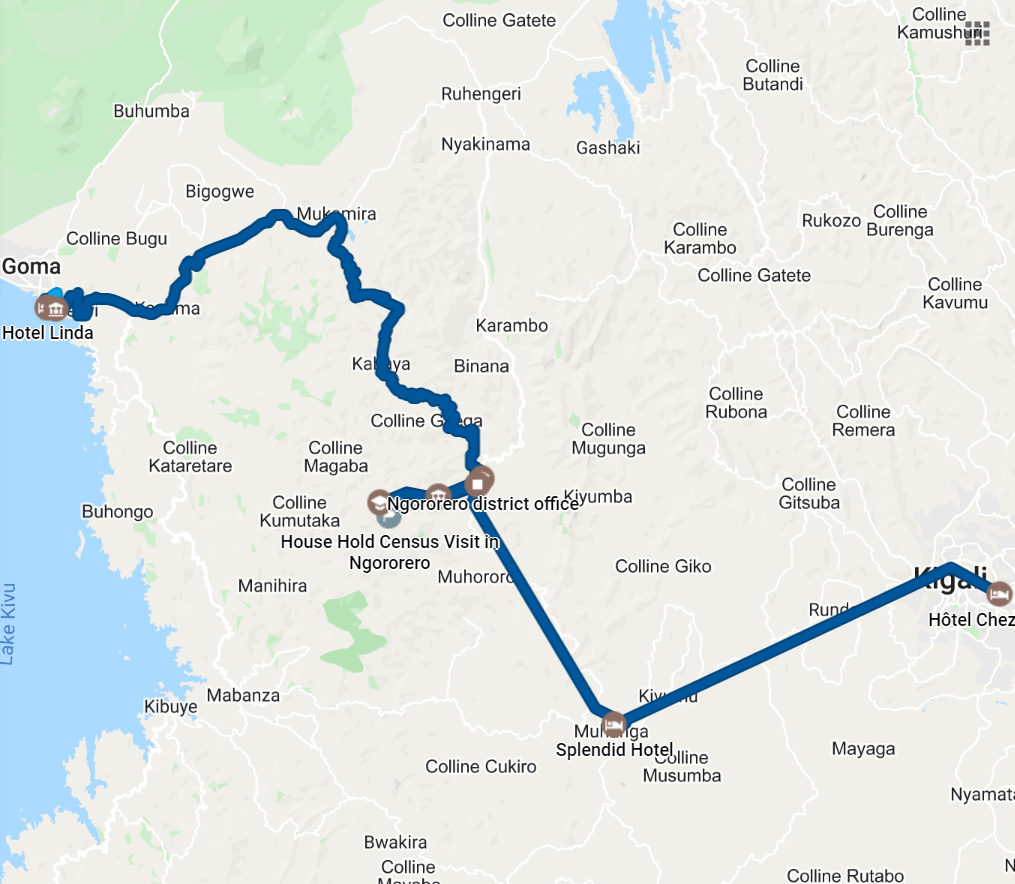
After reaching the GiveDirectly office in Ngororero, we switched to their hired car and drove out to the district government offices. We met with the district government leader to confirm permission to go into the community. From then we headed up into the mountains, split up, (Phil and Sean going with their own GiveDirectly field worker), and then want to observe our first census.
Introducing GiveDirectly
“GiveDirectly is a nonprofit that lets donors like you send money directly to the world’s poorest households. We believe people living in poverty deserve the dignity to choose for themselves how best to improve their lives — cash enables that choice.” In Rwanda, where IntelliTect has donated, each recipient was given a little more than 800 USD in two installments a month a part. Interactions with the recipients are as follows:
Community meeting: a section of 2-3 hundred recipients is gathered together and informed about the unconditional cash they are going to receive and how the process works.
A meeting with each household occurs, called a census, where information is gathered to support the process and, if necessary, a phone and SIM card is provided in support of a mobile bank transfer to the recipient.
Recipients are contacted by phone and informed about the cash transfer.
Cash is transferred in two installments separated by a month.
A follow up “audit” occurs in which GD asks recipients how they spent the money.
GiveDirectly Census
The census I observed was led by Priscila and I had my friend Cedric (whom I met earlier) help with the translation. We were accompanied by the chief of the district and two armed police they brought with them. I suggested that armed police might interfere with the census process but I was assured they were for “our protection” and the GD staff acquiesced.
The process went something like this:
Introductions
Explain the program
Confirm that the cash transfer is non-conditional
Caution the household of potential scams
Ask the recipients which of the heads of household would be the official recipient (if no preference is specified, GiveDirectly chooses the female) and get confirmation that both participants agree. About 60-80% of the time the household selects the female and if the couple doesn’t express a preference, GD chooses the female.
Document all income-generating activities – surprisingly, this didn’t record the amount of income, just the various activities (more on this later)
Provide the option for a new Motorola phone (<15 USD value subtracted from the total cash transfer) with instructions on the mobile banking (via which they will receive the cash transfer)
Review guidelines (like no conflict – more on that later) and spending exclusions (which include drugs&alcohol, gambling, and high-interest loans)
Confirm identity and electronically sign acceptance agreement
Photos of both recipients, family, and the house (inside & out)
Goodbyes/thank-yous
Generally, a household census is expected to take around 30 minutes but ours was more like 50 (presumably because of the pesky foreigners that were getting in the home.)
It was a well-run process. In addition to the optional phone, the household was provided with a handout explaining the program and identifying the amount of the cash transfer. The census data was recorded in a mobile-enabled, offline (Salesforce) application which included the recording of all photographs.
Before the census, the recipients didn’t know exactly how much they were going to receive – well except for rumors from the neighbors. The actual transfer would occur in two separate transactions, the first within a month or so and the second a month after that. Regardless, once the amount was confirmed, the joy and excitement of the recipient household was overwhelming. In fact, when we left and passed a second household who Priscila would be taking a census with next, the mom came out and gave me a big hug. As a GD field worker, Priscila’s job was to meet and take a census with 10 households per day, which included the time taken to travel between households.
Community Meeting
By this time we were running late for the community meeting. This was where GD would announce to the next community that like their neighboring community before them, they would be receiving the unconditional cash transfers. As we approached the building — an old auditorium from a private school that had closed due to a lack of paying students — we could sense the excitement. When we walked in everyone was celebrating by singing. The song was a gospel-sounding government song about following the rules and something about security. It was emotional to hear, but upon learning the translation, it seemed eerily like George Orwell’s 1984 — but no one seemed to be aware or have any concern. Interesting!
The community meeting outlined the process, covering much of the same information that was presented in the census (which was next after the meeting for this community). In addition, the district chief presented before and emphasized after, how everyone must follow the rules, watch and report their neighbors for any suspicious behavior, and implied that the GD activity was in some way associated with the government. When GD presented, the fieldworker got the crowd excited with a shout of “Give” to which the audience responded “Directly.” An activity repeated throughout to help keep people’s attention and excitement. The meeting ended with questions, many of which were already answered but there were some areas of clarification.
From my perspective, both GD activities were emotionally charged and the joy and excitement palpable. A few times, especially at the start of the community meeting, I had to suppress my emotional joy bordering on any tears leaking out. I was honored and blessed to be there.
One important point to note: GD highlighted that the key goal of the cash transfers was for these people to escape extreme poverty. As a donor, this was exactly what I would hope. Unfortunately, it actually opened up an important question for me.
What was the increase in income from before the cash transfer to (some significant number like) five years later?
A second question related to the point they emphasized during the community meeting: couples should not have conflict in order to receive the cash transfer. This is important because they want unity in the financial decisions the couple is making. While I (obviously) have no conflict in my marriage :), this raised an eyebrow for me:
Why did the census, which asked about marital conflict, only detect conflict two percent of the time when UN Women had the following statistics at the time of this writing:
Physical and/or Sexual Intimate Partner Violence in the last 12 months: 20.7%
Lifetime Physical and/or Sexual Intimate Partner Violence: 37.1%


 Posted by markmichaelis