As we approached our destination for the night, the Drill Ranch., we were stopped by three drunk men demanding we pay a “youth free.” In accordance with best practices for unofficial stops in Africa, Benjamin kept driving. About 15 minutes later, however, the same men were chasing us on a motorcycle, along a narrow dirt road, and yelling at us to stop. We increased speed in the hopes that we would reach our destination and have someone there that could navigate the conflict before it escalated too far. While the men didn’t have any guns, two of them carried beer bottles. In the hurried chase, we missed our turnoff and, after going deeper and deeper in the forest, on a smaller and smaller road, we eventually conceded and stopped. The men approached the car and started demanding payment. They claimed to be youth leaders and that we each owed a youth tax of 5 Naira. After a bit of confusion, anger, and fear on our part, we regrouped and had Benjamin expertly take the lead negotiation. Tension ebbed and followed as the conflict ensued. They threatened to slash out tires and tapped their beer bottles on our window threatening to break them. If reasonable conversation could have occurred, we might have made progress, but as they were all drunk, reasonableness was not a priority for them. Eventually, they agreed to meet us at the Drill Ranch, where Zach, our host and someone they knew, would help work things out. We drove to the Drill Ranch. Once there, only Benjamin got out to meet with Zach and the men (see picture). 30 minutes later, everyone agreed to continue the conversation back in the village tomorrow. And, after another 30 minutes, the men left via the motorcycle they came on. No payment was made but the situation was only temporarily resolved. In the morning, Zach went to the community to speak with the community leader. The leader then came to meet with us and let us know that this was just youth being drunk and this is not normal. He requested that we look past the event as a one-off and be sure to not discourage people from visiting. It wasn’t exactly an apology, and didn’t leave us with any confidence that the youth had been dealt with such that the problem wouldn’t occur again, but the community leaders effort to come and meet with us was appreciated. (2023-09-12)
UPDATE: We heard of another overland couple visiting in the last week and they said no youth tax was demanded. Supposedly, Zach spoke with the village chief and the tax has been removed. (2023-09-24)
We had just started driving when I saw a young girl out of the corner of my eye scream while looking toward the back of our car. She had suddenly appeared from around the front bumper, such that it would have been impossible to see her. The girl was screaming because her friend, whom I later learned was 3-year-old Aisha, had just emerged from near the rear wheel of our car and was now lying on the ground. Oh no! What had happened?
I jumped out of the car and ran back to Aisha, picking her up from the ground and holding her. She was screaming, but there were no visible injuries. Her dad took her from my arms and rushed her on a motorcycle to the clinic. I followed on a different motorcycle taxi and arrived shortly after. They rushed her into a room, and the nurse started to examine her. She was still screaming, but the nurse was unable to find any broken bones. She gave her an injection that I later learned was an antibiotic (Jawaclox). I approached and carefully spoke with Aisha and encouraged her to hold my finger and point her toes. My hope was to determine superficially if anything was broken. She quieted down at the site of a white man gently coaxing her to move her joints. Benjamin arrived shortly after.
There were lots of conversations in a mixture of Arabic and Kugama (also known as Wam or Gengle). I didn’t understand a word and couldn’t quite figure out what was going on. I eventually turned to the nurse and asked about her assessment of Aisha. In sign language and very broken English, the nurse confirmed for me that Aisha was okay. There was nothing broken. More Arabic and Kugama ensued with lots of gestures. Eventually, Aisha’s mom entered and held Aisha briefly before handing her to a different woman to hold. Next, an Imam entered the already crowded room and examined Aisha in the same way that the nurse and I did. He came to the same conclusion, that she was okay. Aisha wasn’t quite so sure and continued to cry uncontrollably save for a moment when she declared to her mom that she would stay away from cars in the future. Everyone laughed quietly.
Next Aisha was taken to a different room with a trained health worker – Dr. Sule. Everyone who works in a Nigerian clinic, at least every male who works in a Nigerian clinic, is called a doctor – regardless of the amount of official education that is commonly associated with that position in the rest of the world. Dr. Sule concluded that Aisha needed some medicines from the pharmacy: children’s multivitamin, Ibuprofen (Philoxicam), a type of heat rub, and a pain reliever (Diclofenac). I was sent to go with the motorcycle taxi to purchase the prescribed items. The first “pharmacy” didn’t have them all but I rounded them all up between the three “pharmacies” I visited (I use the term very loosely to mean a shop that sells mostly over-the-counter medicines. Back at the clinic, I re-entered Dr. Sule’s office, and he explained the prescriptions to the mom and then instructed me to pay the equivalent of 6-7 USD for the antibiotic injections – which would continue for two additional days.
Next, I went on a motorcycle taxi to the police station to fill out a police report. However, the police were on break so I could return and wait at the car. However, I was informed in no uncertain terms that everything was okay and I was no one was in trouble. In less than 15 minutes I went back to the police station and was ushered into a small room. The father was asked to be in the room as well, along with several others on the police staff. In broken English I was asked to share my perspective I said there was no need, what had happened everyone had seen, and the father was welcome to share his perspective first. Following the father’s explanation, the child was called for and the father went to fetch her while the official asked me for all my particulars and carefully wrote them down in his notebook. When Aisha appeared she was examined again, this time by the head of the police. Again, lots of conversation ensued but eventually, the head official informed me that everything was in order, and I was free to leave. There was no problem or further concern. He only requested that a picture be taken of the father and me in front of the vehicle.
Neither Benjamin nor I, nor even Terry or Graydon from the car behind us, were certain exactly what happened. For some time, however, the situation was very tenuous. From stories of African accidents, never mind Nigeria, it was my understanding that when an accident like this happens, the community gets riled up and decides the fate of the driver regardless of guilt or innocence. After Aisha’s health, this was my greatest concern. However, none of these fears materialized. In fact, while scary at the time, in the end, I am very grateful nothing more serious had happened and for the seemingly just system to handle the accident.
Summary Thoughts:
I am very grateful that foremost, there really was nothing critically wrong with Aisha. I confirmed this fact the following day when I reached out to Dr. Sule to check on Aisha. Codiwomple has big wheels, and it is a horrific thought to consider what could have happened.
I’m astounded that there was a healthcare facility in such a remote location (at least a day’s drive from even a small town) and that (aside from the antibiotic) they had some practical options for Aisha’s care. I was assuming I would have to drive Aisha to a hospital many miles away. Again, I’m so grateful that there were no broken bones.
This was an easy scenario where a Nigerian scam could have occurred and the situation blew into epic proportions in order to gain financial advantage. This never happened. I was quite happy to pay for the prescriptions and the medical care.
I was baffled by the lack of care from the mother. She barely even held Aisha much once she arrived at the clinic.
The police department was remarkably just. They wanted to hear both sides of the story and create a police report based on both party’s perspectives. In the end, they assured me that everything was fine and I was free to go.
Before leaving, I had a local walk me to Aisha’s house, where I bid farewell to Aisha and gave her some money (remember, she is 3, so while I put it in her hands, it wasn’t going to her). However, I was glad to give it into the care of the women in the household at the time (there were at least 10 gathered) and not to the father. (While the father might have put the money to good use, women in poverty are far more likely to be good stewards of money than men are.)
On Friday, we needed a part for Codiwompler. Unfortunately, the soonest our mechanic (Grimm’s Auto) could get it was Thursday, delaying us by another week. Stink! Last week, while visiting Philakade (https://philakade.org/) I met Cindi, who is married to Andrew, the CEO of Toyota South Africa (yes, really). After mentioning my trip, she offered Andrew’s help if I should ever need it. I was grateful for the offer but brushed it off. Surely the CEO of Toyota, South Africa had more important things than Benjamin and my trip through Africa.
Fast forward a few days and I need a Toyota part that Grimm’s Auto can’t get hold of. Wait… I might have a connection? I reach out to Cindi to verify permission to contact Andrew. Andrew connects me with Jakkie, who then begins to do some research. A few hours later he finds one, also in Jo’burg. No problem, Judy is flying out to meet us in Cape Town so she can bring the part. Things are coming together.
However, Judy is only allowed one bag at 7kg (15.4 lbs) and Jakkie doesn’t think it is a reasonable ask of Judy to carry car parts in her luggage (I wasn’t as considerate, obviously). Instead, he is going to use Toyota’s distribution system to have the part at Grimm’s Auto by Monday morning. Wow!! Really?
Yes, really… Grimm’s Auto calls me on Monday at 12:30 and reports the part has arrived. We drive the car over and they do the installation, along with an oil change. The car is ready to go by 5 PM.
When Judy arrives she informs us that we, “Are guarded by Angels.” 👍
Last week, I purchased flights from my home in Spokane, WA to Cape Town, South Africa, and then returning from Brussels, Belgium back to Spokane – 5 months later. To get from Cape Town (the Southernmost point in Africa) to Brussels, Benjamin and I plan to drive along the West Coast of Africa to Tunis, Tunisia (the Northernmost point in Africa), through 20-28 countries, across two deserts and numerous areas of unrest/conflict along with many other challenges.
Route sketch from Cape Town to Tunis along with various detours
Lest you think the route is more defined than it is. My initial route was a printed-out map of Africa that I drew a line on along the coast. For the updated version above, I asked Google to map a route from Cape Town to Tunis and then dragged the route around to avoid areas where I know there is conflict, the route is impassable, or based on my intuition of what I thought might be “interesting.”
Why you might ask? Well, my son (Benjamin) just graduated from college, and before he does something responsible (like get a job) or irresponsible (I’ll let you come up with your own examples), he suggested we go on an adventure. Driving across Africa seems like a good example of such an adventure, so that is what we are planning.
Benjamin and Mark completed work on the Land Cruiser
Hanna and I flew to the Southern Tip of Baja California Sur, Mexico this week to continue learning to kiteboard. Last year, at the same time, we went to Punta Chame, Panama for the same. We arrived Sunday evening with the plan to start sailing Monday but there was no wind. We settled instead for a beautiful sunrise and a slack line. The latter seemed like a good practice for balancing on a kiteboard.
Hanna (of course), made it across. I was less astute at the task. Regardless, given no wind, we decided to go exploring West, on the Pacific coast side of the peninsula.
We parked just above Playa Bonita, near the construction of a new resort (The Palm) and I was surprised at how deserted the beach was. It stretched for miles but there were only a few cars and accompanying visitors. From there we hiked North along the coast for less than 2 miles, up and over the rocks looking down on Playa Las Tinajas. Remarkably, there was no one there. Literally, in the entire time we hiked, we only saw one family at the start and then no one. (It’s not like we were on the Eastern Coast of Madagascar or something.)
There were pelicans and seals a little way out from the beach – having a good little laugh at the joy of beach life I expect.
When we returned back to the car we drove to Playa Los Cerritos and stayed a little way out of the new construction area at Cerritos Beach Inn. We chose this location to be the night we splurged for accommodations with an ocean view room. (In hindsight, there wasn’t much point because we loved sitting downstairs overlooking the beach so basically only used the room for sleeping. We appreciated it nonetheless.)
In the morning, a father and son walked along the beach for 40 minutes to the hotel to have breakfast. Upon calling the rest of the family to drive over and join them, the dad realized he had the keys. Whoops! I offered to drive him back, picking up gasoline on my return to the hotel.
We left the hotel around 11:30 heading to Pozas Budistas (translated Buddhist Pools). This was casually recommended by the Kartchner’s – who neglected to mention details like, it’s a 4-wheel drive road, be sure you have a full tank of gas, don’t forget to take lots of water as you are going to be in the high desert for several hours, and oh… by the way, when you get there you won’t find any signs. (Admittedly, they told us to count the 11 water crossings but we missed this detail.) All this to say, the drive was wonderful, but not exactly a paved road.
Not only was the drive an adventure, but the pools themselves were (mostly) great as well. We hike in at one of the upper pools (rather than from the bottom), and so the first pool was a slide. Awesome! That is except for the fact that I took the first slide and when I emerged I was freckled with baby leeches. Yes, really!! What? Who recommends this to their friends I wonder? (The rattlesnake wasn’t a big deal because although we wore sandals on our hike, we didn’t see the rattler until we were back in the car.)
Regardless, not to be deterred, we hiked down the creek jumping along the giant boulders until we reached the main pool. And, since it was hot, Hanna volunteered that I test this pool for leeches as well. It was clean, refreshing, and cool. We swam. We were in a high desert and swimming. It was wonderful.
Awesome rock slide… if it wasn’t for the leeches at the bottom.
We hiked back to the car and continued our journey through the desert to Cañón de la Zorra and Zorro Falls (this was when we saw the rattlesnake).
Zorro Falls…. wait what? A waterfall and freshwater swimming hole in the middle of the desert? Really? Yes, really! It was stupendous.
Should I be suspicious if the cabin has candles and a candle holder?
In the evening (Wednesday night) we stayed in the ecolodge, Rancho Ecologico Sol De Mayo, just above the falls. Internet was only available at the entrance, not at our cabins, and there was no cell service. They do have a restaurant, but it was closed while we were there. If you visit, bring your own food though, as they have a great cooking setup with a grill (they provide the charcoal) and a kitchen with dishes. Rather than staying in the cabin, in fact, you can camp. In addition, they have a host of animals from peacocks to pigeons, and rabbits to horses (no relation to dinner). I loved the atmosphere of the ecolodge and, best of all, it allowed you to access the waterfalls after hours. When we went down in the evening, and had it entirely to ourselves. In the morning, I visited as well and took a glorious swim while the sun came up and shone into the pools. It was stupendous.
The wind was forecast back at La Ventana by 11 AM Thursday morning, so we headed out, a 1.5-hour drive. Unfortunately, wind is not as reliable as that and, while Hanna got out, I didn’t. Furthermore, Hanna spent the morning in the water as there wasn’t quite enough wind and she wasn’t able to actually get up on the board – though it was exhausting nonetheless. In the afternoon we headed back to the hotel for a nap and to catch up on work.
Astoundingly… Friday it was too windy. Wow… this sport is picky about the conditions – at least for beginners like us. Not to be bored, however, we took the opportunity to drive to Playa Balandra – which was beautiful. Unless you hike in, it is only open for entry at 8 AM and 1 PM and we timed it just right to make the 1 PM entry. (We were towards the back of the queue but we still made it into the park.) There is an overlook from which you can see both the inlet and the beach of this epic location. Down in the water, you can walk the entire area with the water below your waist. (I expect the sunrise is spectacular and I’d like to hike in early one morning if I’m ever back in the area.)
Playa El TecolotePlaya El Tecolote
Back in La Ventana, we stopped by the natural hot springs at El Sargento. The timing was great because the tide was still coming in so we made a pool in the hot springs (which were too hot to start), and then waited for the tide to come in to cool it down.
Afterward, we headed to dinner. The restaurant was empty and the owner informed us that the menu didn’t correspond with the food available. We told him that suited us, and we welcomed him to make us something great – just not anything Hanna is allergic to. We both enjoyed our dishes and then switched so we could sample each other’s. Unfortunately, after switching, Hanna’s dish now had some unknown substance that triggered a significant allergic reaction. She took the necessary immunotherapy but it’s especially disconcerting when you are so far from significant medical facilities. Furthermore, while the medicine is life-saving, the after-effects are an unpleasant experience, to say the least.
On Saturday, we finally had wind, not too much and not too little. It’s about time! We watched the usual sunrise from our bedroom window – yes, it was like that every morning we stayed in La Ventana. And, around 10 AM, we watched as the wind blew in from the North. You could see it in the water. And, by 10:30 AM, it was time to sail.
We sailed from the Elevation Kiteboarding School and took the jet ski option – which meant they took us upwind via jet ski and then instructed us as we sailed (or struggled to sail) around the bay.
After the morning session Hanna was exhausted while I decided I deserved another afternoon of the sun in my eyes, water up my nostrils, and saltwater “hydration.” And, since we couldn’t catch an early flight out in the morning on Sunday, we may as well try again in the morning before rushing out for the 2-hour drive back to the airport.
Needless to say, we are close, but at the end of a second week (18 hours in total for me and 12.5 hours for Hanna) we still aren’t quite independent kiteboarders yet. I expect next time, but that’s what I thought last year so….
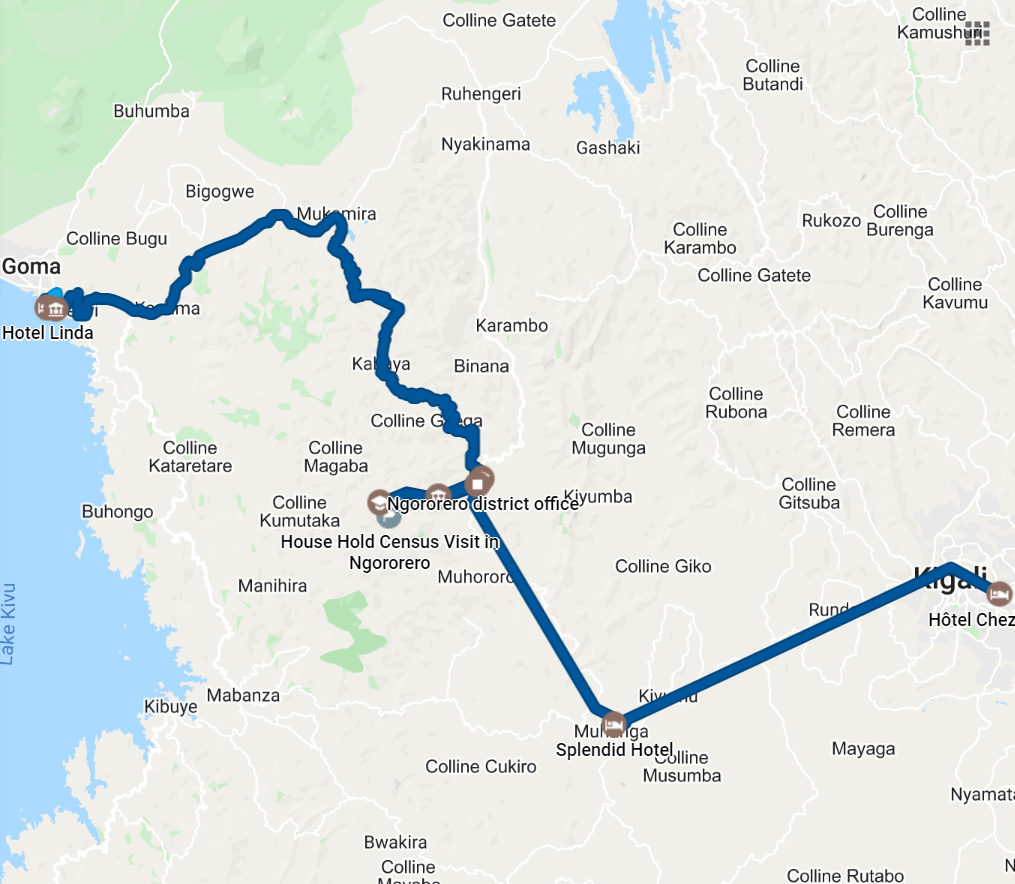
Tonight we fly home, Kigali->Entebbe->Amsterdam->Seattle->Spokane. A total of around 30 hours. Before that, however, we get to go meet with some of the specific households that IntelliTect supported with their donations to GiveDirectly(GD) in 2021. It’s about a 4-hour drive to the village of Gitwa, and we will only be able to stay about an hour before heading back, but none the less, it provides an opportunity to hear first hand about the impact.
Upon arriving in Gitwa, we first went to the government village officers where we met with the section head. He had one of his staff present the impact on the community, using PowerPoint and a projector, comparing before and afterwards.
The impact included:
100 percent of the households had purchased government health insurance (no doubt a government encouraged purchase)
100 percent of the households had electricity – supporting a minimum power equivalent to three lightbulbs
The vast majority owned a cow (another strongly government encouraged purchase)
<more data to come>
After the presentation we got to wonder around the community and I was asked to select any household I would like to visit. Note, as your read these description, they are each anecdotes. They can’t be used to measure overall success of the GD program. None the less, I was encouraged, blessed even, by the interactions.
The Miller – Mugabe Moise
The first building we came to was a flour mill and the owner, Mugabe Moise, was outside. Prior to GD he was renting flour mill equipment and leveraging some training he had attended. Using the cash transfer, he purchase the flour mill equipment, and a second one, outright. He was paying ~5 USD/day for the electricity to run the mill and about 15 USD/month for maintenance. In addition, he seemingly employed one person to run the mills. As a result, he calculated his net profit at the equivalent of 5 USD/day, significantly higher than the 1.90 USD/day ppp value set as the extreme poverty delineator. (Although, I confess I didn’t find how many, if any others, in his household he was supporting.) This was clearly a success story. I suspect he was very likely already above or trending above the poverty line even before the GD money, but regardless, it was a huge success and I’m excited about what the future holds for this gentleman.
The Excited Widow – Musabyimana
This woman, Musabyimana, was so excited she invited us into her home. In the corner was a small wooden bench standing on it side. She explained that before receiving the money, that was the only furniture she had. Now, she had this wonderful set, and the bicycle. She also had a cow and an additional room she had added on for where to put her next cow.
The Farmers – Everist Niyonzima, his wife Uwanyirigira Anne Marie, and their grandchild
This family, Everist Niyonzima, his wife Uwanyirigira Anne Marie, and their grand daughter had peas that were drying on a cloth outside. They said they were for themselves but if they every had excess produce, they would sell it. It didn’t seem like they had any steady source of income and they were seemingly living off of subsistence farming. Their grand daughter lived with them as she was a surprise and so this couple was helping out their daughter.
One of the things they purchased with the cash transfer was a new corrugated iron roof. While they were incredibly grateful for the money, it was hard to gather what they had spent it on and the impact it had made.
(When we asked to take a picture the Everist asked if he could please go get changed first as he wasn’t expecting visitors.)
We met a few more folks during our hour long walk. Some of them invited us into their home. All of them were extremely grateful. None of the remaining ones provided a clear indication that they had used the money to establish a stable income. All of them expressed joy at their improved quality of life due to the various spending that included:
Furniture
TV and speaker
Land for their children
Improved stucco walls
Painted their houses
A cow
Additional rooms
On the way back to the car, however, we met two folks that were working to establish a business:
Leveraged the cash for establishing a mobile banking stall within the community
Bought a cow and sold it at double in the town (15-30 minutes from the village), with the intent to purchase more cows from the community that he could sell
Following my visit, I took some time to write up my impressions and questions regarding GiveDirectly. In summary, I can say with confidence that it was a blessing to be able to see their gratitude, excitement, and accept their thank-yous.
After reaching the GiveDirectly office in Ngororero, we switched to their hired car and drove out to the district government offices. We met with the district government leader to confirm permission to go into the community. From then we headed up into the mountains, split up, (Phil and Sean going with their own GiveDirectly field worker), and then want to observe our first census.
Introducing GiveDirectly
“GiveDirectly is a nonprofit that lets donors like you send money directly to the world’s poorest households. We believe people living in poverty deserve the dignity to choose for themselves how best to improve their lives — cash enables that choice.” In Rwanda, where IntelliTect has donated, each recipient was given a little more than 800 USD in two installments a month a part. Interactions with the recipients are as follows:
Community meeting: a section of 2-3 hundred recipients is gathered together and informed about the unconditional cash they are going to receive and how the process works.
A meeting with each household occurs, called a census, where information is gathered to support the process and, if necessary, a phone and SIM card is provided in support of a mobile bank transfer to the recipient.
Recipients are contacted by phone and informed about the cash transfer.
Cash is transferred in two installments separated by a month.
A follow up “audit” occurs in which GD asks recipients how they spent the money.
GiveDirectly Census
The census I observed was led by Priscila and I had my friend Cedric (whom I met earlier) help with the translation. We were accompanied by the chief of the district and two armed police they brought with them. I suggested that armed police might interfere with the census process but I was assured they were for “our protection” and the GD staff acquiesced.
The process went something like this:
Introductions
Explain the program
Confirm that the cash transfer is non-conditional
Caution the household of potential scams
Ask the recipients which of the heads of household would be the official recipient (if no preference is specified, GiveDirectly chooses the female) and get confirmation that both participants agree. About 60-80% of the time the household selects the female and if the couple doesn’t express a preference, GD chooses the female.
Document all income-generating activities – surprisingly, this didn’t record the amount of income, just the various activities (more on this later)
Provide the option for a new Motorola phone (<15 USD value subtracted from the total cash transfer) with instructions on the mobile banking (via which they will receive the cash transfer)
Review guidelines (like no conflict – more on that later) and spending exclusions (which include drugs&alcohol, gambling, and high-interest loans)
Confirm identity and electronically sign acceptance agreement
Photos of both recipients, family, and the house (inside & out)
Goodbyes/thank-yous
Generally, a household census is expected to take around 30 minutes but ours was more like 50 (presumably because of the pesky foreigners that were getting in the home.)
It was a well-run process. In addition to the optional phone, the household was provided with a handout explaining the program and identifying the amount of the cash transfer. The census data was recorded in a mobile-enabled, offline (Salesforce) application which included the recording of all photographs.
Before the census, the recipients didn’t know exactly how much they were going to receive – well except for rumors from the neighbors. The actual transfer would occur in two separate transactions, the first within a month or so and the second a month after that. Regardless, once the amount was confirmed, the joy and excitement of the recipient household was overwhelming. In fact, when we left and passed a second household who Priscila would be taking a census with next, the mom came out and gave me a big hug. As a GD field worker, Priscila’s job was to meet and take a census with 10 households per day, which included the time taken to travel between households.
Community Meeting
By this time we were running late for the community meeting. This was where GD would announce to the next community that like their neighboring community before them, they would be receiving the unconditional cash transfers. As we approached the building — an old auditorium from a private school that had closed due to a lack of paying students — we could sense the excitement. When we walked in everyone was celebrating by singing. The song was a gospel-sounding government song about following the rules and something about security. It was emotional to hear, but upon learning the translation, it seemed eerily like George Orwell’s 1984 — but no one seemed to be aware or have any concern. Interesting!
The community meeting outlined the process, covering much of the same information that was presented in the census (which was next after the meeting for this community). In addition, the district chief presented before and emphasized after, how everyone must follow the rules, watch and report their neighbors for any suspicious behavior, and implied that the GD activity was in some way associated with the government. When GD presented, the fieldworker got the crowd excited with a shout of “Give” to which the audience responded “Directly.” An activity repeated throughout to help keep people’s attention and excitement. The meeting ended with questions, many of which were already answered but there were some areas of clarification.
From my perspective, both GD activities were emotionally charged and the joy and excitement palpable. A few times, especially at the start of the community meeting, I had to suppress my emotional joy bordering on any tears leaking out. I was honored and blessed to be there.
One important point to note: GD highlighted that the key goal of the cash transfers was for these people to escape extreme poverty. As a donor, this was exactly what I would hope. Unfortunately, it actually opened up an important question for me.
What was the increase in income from before the cash transfer to (some significant number like) five years later?
A second question related to the point they emphasized during the community meeting: couples should not have conflict in order to receive the cash transfer. This is important because they want unity in the financial decisions the couple is making. While I (obviously) have no conflict in my marriage :), this raised an eyebrow for me:
Why did the census, which asked about marital conflict, only detect conflict two percent of the time when UN Women had the following statistics at the time of this writing:
Physical and/or Sexual Intimate Partner Violence in the last 12 months: 20.7%
Lifetime Physical and/or Sexual Intimate Partner Violence: 37.1%
Before breakfast, and like the previous day, I awoke, worked for a couple of hours, and then joined up with Phil and Sean for a walk. This time, however, we decided to be more deliberate in walking into areas that were less tourist and commercial (but staying within the safety boundaries suggested by the hotel). We headed north along the main road until we found a dark enough alley – and in this case, I’m referring to enough of the black, volcanic dirt for a road rather than something paved. It was great. We were able to interact with the locals by playing pool and soccer, and obtain a sense of what the real Goma is like behind the preponderance of NGO buildings on the main streets. (Sean suggested we play NGO bingo.)
(See more journaling below, but there are lots of photos.)
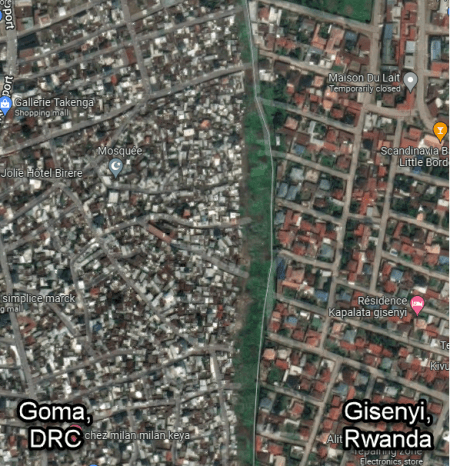
Our time in DRC was brief and World Relief was careful to keep us in relative safety, avoiding taking us outside of Goma. For example, World Relief even avoided letting us see the volcano, which was only 100 miles away. I quickly accepted this (albeit disappointed). However, this short walk around a poorer neighborhood of Goma was a highlight. It gave us a clearer picture of how the urban population lives than our mostly car-limited view the prior two days. Additionally, part of the walk took us along the DRC-Rwanda border. We could see the stark contrast between Goma, DRC and Gisenyi, Rwanda as we walked along the border, with wood “slum-like” housing on the DRC side and brick structures on the Rwanda side. The “satellite view” between on its own reveals the inequalities.
The satellite contrast between Goma, DRC (left) and Gisenyi, Rwanda (right)
Upon our return to the hotel we packed and grabbed breakfast before checking out and meeting our driver from World Relief. Checking out was somewhat painful as getting each receipt, of three, took nearly 10 minutes and yet when I went to the “payment” room they only charged me for two rooms. I questioned them and they said it was fine. Knowing that they were underbilling, however, I repeated and insisted they had made a mistake. They finally went to check and then wanted to reinvoice while I waited. We were running late so I insisted on paying and letting them figure out the invoicing process after I left.
Our driver took us to the border. Here, we left the car and walked through security with our bags while they scanned the car for misappropriate material. We then went through DRC immigration followed by Rwanda immigration. Since we have a multi-entry East Africa visa we hoped they would just let us in, but no such luck. The multi-entry East Africa visa allows you to pass between Kenya, Rwanda, and Uganda an unlimited number of times, once you leave those three countries, the visa expires – so we had to get a new visa. And, hoping we were going to Burundi (but no East Africa countries) later that week, we opted for the multi-entry Rwanda visa, paying 70 USD rather than 50 USD. Our driver insisted on staying with us until we had completed the immigration process – which took about an hour, but now that we were done, we said good-byes and continued into Rwanda. Unlike on the DRC side, there were not motorcycle scooters (motos) waiting for passengers. However, we walked down the street a ways and found a taxi area. We negotiated the rate and then each boarded a separate moto for a ride back to the car (totaling 4.50 USD and about 10 minutes journey). I was happy that I finally got Phil on some local African transportation, but don’t tell his Cathy it was my choice to use a moto please.
Unfortunately, since we were late, we had to skip our planned swim in Lake Kivu and continue on our way to Ngororero for our meetings with GiveDirectly.
Travel Summary: 5h 5m driving 32.2 km, 47 m walking 3.7 km
Today, I woke early and spent time trying to catch up at work before heading out with Sean and Phil for a morning walk around Goma. At 8 AM, we went to the World Relief Office in Goma and met with the team there.
They reviewed the various programs that World Relief is running. I was impressed. In addition to our visit to the clinic yesterday where World Relief is funding the fistula surgeries, they also have numerous additional programs. Below are some highlights. Notice the broad “wholistic” focus, with programs covering everything from GBV, couples facilitation, to Savings & Loan programs.
Sexual Gender-Based Violence (SGBV) and HIV programs Helping survivors with:
Self-confidence
Overcoming physical obstacles caused by SGBV (such as providing fistula surgery)
Help with social and spiritual poverty, including helping them know and believe the truth that they are valuable to God and that he can help restore their life
Process
Train church and community leaders on how to care for survivors
Establish SGBV/HIV awareness groups
Identify survivors
Physical rehabilitation
Socio-economic reintegration
Psychosocial reintegration
Spiritual rehabilitation
Community Empowerment Zones
Work with local church and community leaders to start collaborating on poverty in the region and how they can help.
Train the trainer education for local and community leaders with World Relief wholistic program curriculum
Agriculture 200 farmers empowered with livestock and agriculture support
Food Security and Livelihood Providing seed, tools, and technical training for farmers
Peace training to help resolve conflict
Saving for Live Saving and Loan programs
Trauma Healing
Community Health
Families for Life (FFL)
For dinner the night before I met with the director of the Families for Life program as was impressed with all they are doing and the impact it is making. I confess there are times that I assume that people in extreme poverty are not ready from programs like this. However, I am just wrong. In fact, when you are living under constant stress and you need help navigating complexities, programs like this provide direction and support that can be crucial.
One of the interesting effects of programs like Families for Life (FFL) is that more couples are going to government offices for civil marriages in addition to their church wedding. Why you might ask? Most couples are getting married in churches which the government doesn’t recognize. And, if something happens to your partner, there is no common law marriage which allows assets to be inherited from one partner to the other following death. Thus, the surviving partner can be left with nothing. However, since the FFL program teaches couples the importance of the civil wedding, more and more couples are going through the process and so they are protected.
Intuitively I fully support the various programs that World Relief has and I’m excited about the impact it is making. My one disappointment is that there isn’t any real data that points to the impact. There is no measurement of things like increased income over time (like Capable has). Even if this metric is not relevant to World Relief, are their other metrics they should be measuring? Discussion on the topic this morning didn’t result in any clear changes or identification of metrics that should be pursued, but I’m hoping for follow on discussions after I leave. I’m trying to be careful to not force Western quantitative ideas onto cultures where they don’t work, but I’m also wanting to push the organizations we partner with to excellence and being able to measure the excellence.
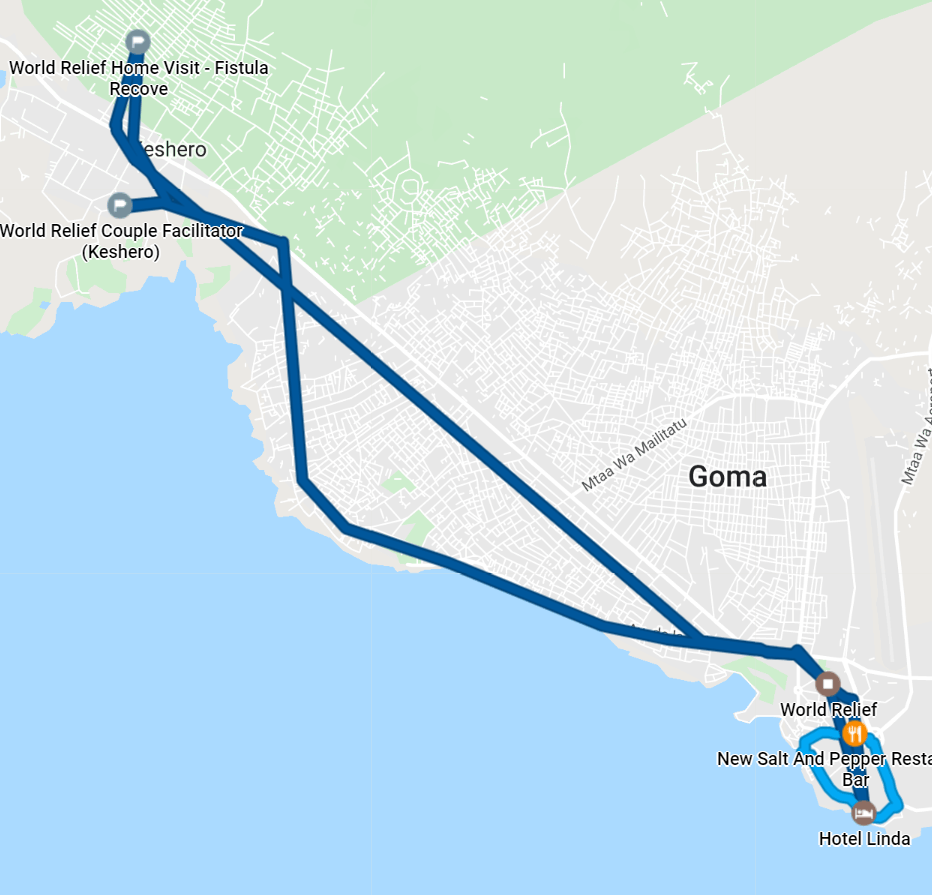
Following out morning meeting at World Relief – DRC headquarters, we headed out to a church to meet with local pastors who have been collaborating with World Relief.
It was interesting that prior to World Relief’s initiative, there was very little collaboration between pastors. Furthermore, the church was essentially only focused on their own congregants. After the training, pastors saw the value in collaborating and reaching out to the community. One church had reached out to widows and provided housing for them. It was a blessing to care for them and the widows were blessed by the desperately needed assistance. Another couple had separated because the wife was disrespectful to the husband because he couldn’t find a job. The situation escalated to such an extent that she had moved out. However, through the FFL program, the couple had reconciled and was living together again.
Of course, this was all good, but the underlying problems were just as insidious as before. The widows still didn’t have any source of income and there was no plan in place to change that. Was the church planning to support them indefinitely. While some of the widows were in their 60s, many were still in their 20s and 30s. What was their long term plan and did the church have any ideas how to help move them to self sufficiency? No one new the answer and no one was even asking the questions. And, while I asked the question, I was no better since I had no answers either. Similarly, while it was great that the couple was back together, the husband still didn’t have a job or even a prospect for one. While harmony was great and all, there was a young child likely going under nourished and a family barely making it from day to day. All the marriage counseling in the world wouldn’t alone fix this. (I’m feeling discouraged.)
Our next stop was to the home of a woman who was underwent fistula surgery at the clinic we saw yesterday. Oh my! We all crowded into her living room and sat on the couches as she shared about how her life had changed. At one point she literally stood up and danced, describing in effect, how she has a new life. For those unaware, I quoted both USAID’s traumatic fistula and UNFPA’s obstetric fistula descriptions here. The first is caused by rape and the second by child birth.
For this women, her marriage had been restored and was no longer ostracized by her community.
The next home we visited was with a couple that has participated in five days of “couple facilitator” training, the focus was to have them be able to help council other couples as the navigated the difficulties of marriage. More immediately, the training had impacted their own marriage, so much so that their daughter testified to the significant difference she saw in her parents. The mother especially, shared how much different things were because of her husband’s new found understanding of equality and respect. As I’ve already commented, not knowing anything about “couple’s facilitator” training, I probably wouldn’t have supported something like this if I’d known up front. In hindsight, however, I can see the impact and the importance on helping improve family collaboration and unity as the navigate the challenges of poverty.
We ended the day having dinner with Jean, the World Relief – DRC country director. This too was a great opportunity to learn more about the day to day challenges faced with serving there. Jean also shared the harrowing situation he lived through as he tried to relocate and protect his staff during the volcano in May of 2021. Lava was flowing into the city of Goma and gobbling up everything in its path, making an already challenging humanitarian situation exponentially exacerbated with a natural disaster. Ughh!!
After entering the Democratic Republic of Congo (DRC), we dropped our bags at our hotel and headed for a women’s health clinic. Some of IntelliTect’s philanthropy has been supporting fistula surgeries at this clinic, many of which are caused by rape. Here we met with the head doctor and discussed with her the prevalence of gender-based violence (GBV) in the DRC. In the DRC:
For those of you who are unaware, untreated fistula problems can cause you to smell constantly as your bowels are perpetually leaking. Frequently in this part of the world, your husband will disown you. Furthermore, the cause is violence or child bearing (sometimes because of rape). Here are USAID’s and UNFPA’s descriptions (not for the faint of heart):
Traumatic fistula is a condition that can occur as the result of sexual violence, often in conflict and post conflict settings. There are no solid estimates of its prevalence, but traumatic gynecologic fistula can make up a significant part of the overall genital fistula caseload in places where sexual violence has been used as a weapon of war.
Rape, often aggravated by the thrusting of objects into the vagina, can result in a hole between a woman’s vagina and bladder or rectum, or both, resulting in the leaking of urine and/or feces. Survivors of sexual assault may have additional, severe physical injuries and are at an increased risk for unwanted pregnancy and sexually transmitted infections, including HIV. Survivors live not only with chronic incontinence, but also with the psychological trauma and stigma of rape.
Obstetric fistula is one of the most serious and tragic childbirth injuries. A hole between the birth canal and bladder and/or rectum, it is caused by prolonged, obstructed labor without access to timely, high-quality medical treatment. It leaves women and girls leaking urine, feces or both, and often leads to chronic medical problems, depression, social isolation and deepening poverty. Half a million women and girls in sub-Saharan Africa, Asia, the Arab States region and Latin America and the Caribbean are estimated to be living with fistula, with new cases developing every year. Yet fistula is almost entirely preventable. Its persistence is a reminder of gross inequities, a sign of global inequality and an indication that health and social systems are failing to protect the health and human rights of the poorest and most vulnerable women and girls.
We spoke with the doctor (in yellow below) at length and she was quite open about her experiences. She talked about how the surgery was not always sufficient because in many cases when the women leave the clinic they are going back to the same crappy circumstances in which they were abused in the first place. She talked about the never-ending line of patients but the limited resources that allowed them to be treated. It was a sobering meeting.
Also, while fistula surgeries are amazing for the patients, they are not reducing the frequency of cases caused by violence. In fact, most women here are stigmatized by the problem and do their best to keep it secret. Only when World Relief (the NGO we partner with in the DRC) meets the women and is able to get to know them, do they discover the problem and persuade the patient to seek medical attention.
Afterward, we were invited to go visit some of the patients – all of whom had given permission for photos and conversations. In addition, we got to see the surgery room.
Notice that these women are still caring for their children while they are in hospital – generally a stay of up to 21 days (14 in recovery and 7 in physical therapy). While we’ve had several sobering moments throughout our trip, this was one of the worst and most memorable.
Here are some more statistics regarding DRC poverty and injustice:
In the evening, we went out to dinner with the World Relief team and discussed the various ways they are fighting poverty in the DRC. It was a great conversation and I learned about all sorts of cool things they are doing.
Earlier in the Day
I confess, that my morning was an embarrassing contrast with the clinic visit. I awoke in time to get up and watch the sunrise. It wasn’t particularly spectacular, but I love that time in the morning and it was good to spend some quiet time pondering our experience so far.
After Swimming in Lake Bonyonyi (2022-04-18)Swimming after breakfast in Lake RuhondoLake RuhondoBoating Back from Overnight on the PeninsulaThis woman bails water from the boat with her paddle with a baby on her back in order to take her son to schoolSunrise on Lake RuhondoSunrise on Lake Ruhondo
Following breakfast, we threw our gear in the boat and headed back to the other side of the lake – stopping of course for a brief swim along the way. Once we made it back to our trusty Toyota Land Cruiser, we headed into town and purchased a SIM card and withdrew some money. I also befriended one of the youth I met on the street and connected with him on WhatsApp. Over the past few days we have had several interesting conversations about the Rwandan Genocide, but more about that when we return to Rwanda.
My new Rwandan friend, InnocensePassports stamped… we entered the DRCImmigration is on the water – here’s the view upon entering the DRC Immigration Lines to Leave RwandaWhy not?Bike repairCome on, admit it, you’ve wanted to do thisOnion harvest (in Uganda)Love This!
Unfortunately, leaving Bwindi required us to backtrack a noticeable portion of the road we traversed the previous day. Fortunately, however, it was daytime so it wasn’t nearly as bad. And, once we were back on the main road, we immediately took a detour down to Lake Bunyonyi so Sean and I could take a quick swim. I was delighted as I assumed no swims would happen due to the prevalence of Bilharzia/Schistosomiasis, a parasitic disease from infected water that can result in serious damage to the internal organs. Fortunately, Lake Bonyonyi doesn’t have any so we went swimming. 🙂
With that out of the way, it was time to head to Rwanda. On the way, Sean pointed out the rock splitting. Large road construction rocks are deposited on the side of the road and then workers are hired to split them into smaller sizes with a small hammer. Wow! Can you imagine?
The drive through the mountains in South Eastern Uganda is spectacular. In spite of the steep, mountainous terrain, it seems like the farms are densely packed together and all arable land is farmed.
It wasn’t long before we reached the border. A couple of things to note, however. Firstly, there is a time change between Uganda and Rwanda, so make sure you pay attention to which way you are traveling and whether the time change gives you an extra hour or subtracts an hour when crossing. Secondly, Rwanda drives on the right side of the road, whereas in Uganda we drove on the left-hand side – so pay attention to when you turn.
Crossing from Uganda to Rwanda
For our first night in Rwanda, we took a boat across Lake Ruhondo to our accommodations on a peninsula unreachable by land (we tried).
Travel Summary: 13h 27m driving 483 km, 30 min hiking 1.8 km
Travel Track for Day 4
One of the organizations that IntelliTect supports is the International Justice Mission (IJM). One of the reasons for passing through Fort Portal was to meet with IJM to gain a better understanding of the injustice fighting work they are doing there around gender-based violence (GBV). Disappointingly, the leadership was traveling over the Easter weekend and we were not able to meet. It wasn’t the same; however, we have one of the victims of GBV coming to visit IntelliTect next month and meet with those interested in the work that IJM is doing in Uganda (let me know if you would like to attend). In lieu of such a visit, we continued on our journey along the Western side of Uganda with our longest travel day yet.
Following breakfast, we drove South crossing the equator (my first time on land), and then on to the Kyambura Gorge. (The latter has chimpanzees but that will have to be saved for another visit.) The gorge is impressive in its invisibility. If you didn’t know it was there, you would never see it. You look across the landscape and it is spotted trees and grass (African veld) as far as the eye can see. However, if you drive across, you suddenly encounter the gorge without any notice. We also stopped by the Kyambura Gorge Lodge to make a quick hike down to the river.
When driving long distances, with little infrastructure along the way, mindfulness of gas stops is obviously important. This is especially true when driving a Toyota Land Cruiser (albeit diesel) with over 200,000 km and a broken gas gauge. Frequently, the stops proved to be interesting, whether it was a manual gas pump or a small fishing village with hippos, sacred ibis, and hammerkop on the beach.
This gives pumping gas a new meaning
The final stretch was perhaps the most eventful with treacherous roads that extended on well after dark. Both Sean and the Land Cruiser were amazing – I’m pretty sold on the latter as my vehicle of choice if/when I drive the length of Africa, and I wouldn’t complain if Sean was my driver either.
Experiencing the Ugandan Roads
The water crossing below was way more impressive when we first drove up and I hadn’t waded through and checked the depth.
Water Crossing
The goal was to reach the Bwindi Impenetrable Forest by nightfall. And, while we could have taken the direct 7-hour drive, we decided to take a “slight detour” through the Queen Elisabeth National Park. Unfortunately, however, it ended up a lot more of a detour than we intended. While we did see a few elephants, giraffes, and baboons, they were brief encounters and didn’t warrant the extra ~6-hour drive over hair-raising, four-wheel only, cliff-hanging roads, and even a river crossing.
In 2020, “Uganda reported the highest number of Gender-Based Violence (GBV) cases in East, Central and Western Africa with 60% of girls and young women aged between 13 to 24 years having experienced one or more types of violence in childhood. In the same report, 72% of Uganda’s young population (aged 18–24 years) have also experienced one or more types of violence before the age of 18 while 25% of young women in Eastern Africa justify a husband beating up his wife” – Increasing cases of Gender-Based Violence in East Africa.
I want to confess at the start I’m afraid to share this story. There were numerous immediate judgement calls throughout the encounter and I don’t know that we always made the right choice. However, if nothing else, it speaks to the prevalence of the problem and for that I’m choosing a little bravery at the risk of potential criticism. I’m not saying our actions were correct, or that we shouldn’t have done more, just describing the situation as we experienced it. Please know that it was difficult and no doubt you, dear reader, would have chosen better in the moment but I’m sharing anyway.
It was after 10 PM with no moon. We (Sean, Phil, and I) were about 30 minutes from the Bwindi Impenetrable Forest when we drove past a couple when the woman, somewhat quietly, pleaded for help through our open car window. Sean heard the plea and asked if she was okay. She was around 18 and the man holding her was perhaps in his early 20s. We hesitated but soon stopped the car and stepped out requesting the man to let her go. He refused, claiming she was his wife and wouldn’t let go. (Obviously being her husband doesn’t give any right to forcibly hold her like he was, but the man was drunk and there was a huge language barrier between us.) The couple crossed the dirt road and we stepped toward them. However, the man would not let go. We tried talking but there was essentially no communication due to the apparent language barrier. We suggested he just stop and let her go so we could talk, but he refused. There was more struggling and us peacefully but physically trying to free her. Everything we tried verbally was completely ignored.
The couple backed up to a wood hut and Sean took one arm while I took the other in the hopes of freeing her. However, his grip on her purse was relentless and she wouldn’t let her purse go. Shortly afterwards, additional men appeared and he seemed to be insinuating to them that we were stealing his wife. Yikes!! What is going on? Dang-it, I don’t speak the language. The man then told us that we could have her but it would be 3,000,000 UGX (about 900 USD). What? Are they seriously implying that we are trying to steal her?
We backed away trying to avoid anyone really getting hurt and she freed herself and ran behind Phil. However, the “husband” grabbed her again and wouldn’t let go this time. There were now a total of five men, all in the low 20s, and drunk. A couple of them grabbed tree branches and stripped off the shoots to create poles which they started swinging at us wildly, occasionally connecting with a hit or a kick.
With the threatening sticks we ended up separated, with the men and the woman on the other side from us. I tried taking one of them aside and talking with him but regardless of what I said, he replied with “go away.” The situation was degrading fast. I so wish the woman had run once she got free but how was she to know that?
The “husband” said something to the woman about knowing that the woman’s stuff was in his house? (Why was this in English? Did he understand more than he let on?) Even if we could free her, what happens tomorrow or the day after? Is she going to be punished worse because we were involved?
They started moving away and a couple of them took the upper road, looking down on us. They started hurtling rocks. They loudly hit the tin roof of the hut or skidded on the road, but they were all wild throws – not surprisingly given their inebriated stated.
With rocks flying past we decided to get in the car. But as we headed in the direction, the man held the woman’s body while two of his buddies lifted her legs and carried her back up the road. Stink! There is no circumstance where that behavior is okay. With the two other men guarding with additional rocks, what were we supposed to do? Should we do everything in our power even if it involves violence or bodily harm? If they are using physical force, does that justify it for us given their violence against the woman? After all, from everything we can tell, she is being forcibly held against her will, but we are also being accused of stealing her.
We drove down the hill, mostly in silence. We felt horrible not knowing what might happen. Even if we could help, would it make it worse in the long run? I don’t know. It’s so frustrating that we don’t speak the language.
15 minutes later, at the bottom of the hill, we reached a road block and spoke with a military guard who called the police. However, the police didn’t have a vehicle and would take more than an hour to reach the location. The guard eventually agree that we give him a ride to the location. Of course, after 30 minutes, the chance of finding them at night was miniscule, exacerbated because we were in very steep and dense terrain. Regardless, the hope seemed worth the attempt.
Once we returned there was no one associated with the events in sight. We went up the road 200 ft. and the guard asked those milling around if they had seen anything, but the response was in the negative. Briefly we saw someone hiding in the bushes and the guard (who was carrying a rifle) lunged at him but the man disappeared into the bush down a steep embankment. So frustrating!!!!!
In the end all we could do was take the guard back to his post and hope that there would be follow up in the morning and the real truth would be told, not some story about us trying to steal the woman.
April 23 Update:
Sean chose to take a detour towards the same area rather than drive directly to Kampala. He had some contacts in security and reached out to them for help. Even though it is almost a week later, here’s what he had to report:
“People talk – so believe it or not – it looks like the police here are gonna find the guys. This cheeky old man I came across had heard all about it and connected me with the police (their place is 1 km up the other road) and provided two of their names and locations. Anyways, more progress than I expected. I’ll keep you posted. I pulled off and this Mzee (older man) came walking past me – spoke good English so I chatted with him. He is the main guy’s neighbor and overheard them when they got back that night and the next morning. Knew all the details. The guys were all hiding in the bushes and saw us with the soldier when we came back. The woman got taken back to the house, but left the next morning.
The Mzee is going to communicate with her and help her make a statement. I have all the numbers of the police and will follow up. It was a long shot, but I’m stoked I was able to get the wheels turning to hopefully provide some protection for her moving forward.”
In the end, could we have done better? I’ve gone over it a thousand times and there isn’t a clearly better approach that I can think of. Suggestions? Perhaps if we had more swiftly freed her before others arrived but we were still trying to find a peaceful solution.


 Posted by markmichaelis